The takeaway
A relatively small company can have a full, complex production cycle. The value of ERP becomes clear when the team can manage that cycle without maintaining a parallel set of production spreadsheets.
A small manufacturer with a full production cycle
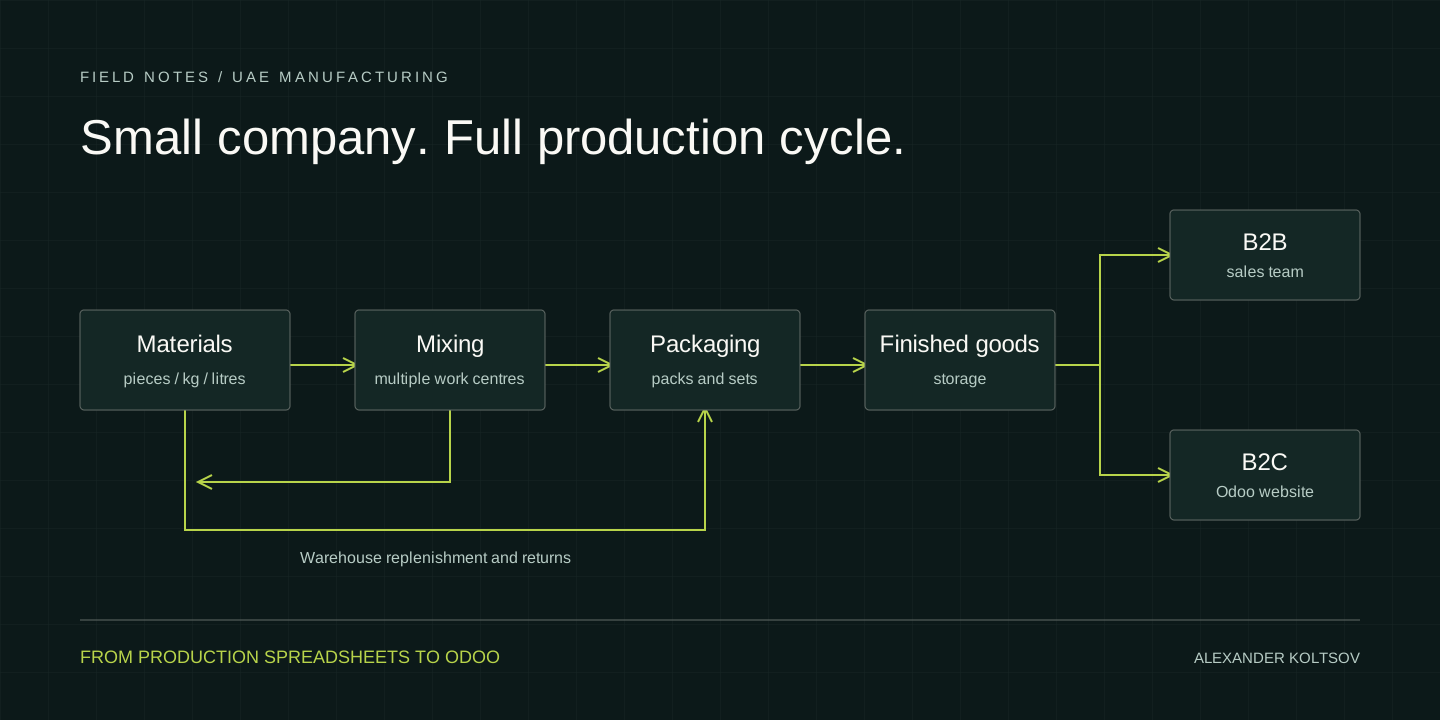
The company is based in the United Arab Emirates. It is relatively small, but its processes are already quite mature. Raw materials are purchased in pieces, kilograms and litres. Components are mixed in several stages, and materials move from one work centre to another.
The actual flow also includes exceptions. A work centre may need additional material from the warehouse, or have a surplus to return. Those movements need to be recorded too. Then come packaging, finished-goods storage, assembling product sets and sales.
B2B sales are handled by the company’s own sales team. B2C orders come through its website, which also runs on Odoo. There is a complete operational chain here, from incoming materials to the customer. Being a small business does not make that chain simple.
My role in the Odoo implementation
My team and I delivered the Odoo implementation: configuration, data imports, training and documentation. I remember conducting the first training sessions in December 2025, when the production spreadsheets were still central to daily work.
The work took roughly three months, including the New Year holidays, and we launched in early 2026. The conversation with the managing director gave me a view of what had stayed useful after launch: how the team managed production, how a new manager learned the system and how the investment compared with the alternative they had considered.
Odoo for manufacturing meant leaving Excel behind
The first thing the managing director mentioned was that they had stopped using Excel to manage production orders and their statuses.
I remember our first Odoo training sessions in December 2025. Those files were everywhere: enormous spreadsheets, cells highlighted in different colours, production tasks and their statuses maintained by hand. They were part of how the company kept track of what was happening.
Moving that work out of Excel feels like a real win. For many businesses, getting away from manual updates and a web of connected spreadsheets is a substantial step forward. It gives the team a shared place to see the work, without having to reconstruct the situation from several files. It also creates room for growth: more activity does not have to mean proportionally more spreadsheet maintenance.
A new production manager found his own way around
The second point was the interface. This can sound almost too obvious to mention, but the client’s example made it very concrete.
A new production manager joined in the middle of the year. According to the managing director, he worked out the interface himself: how production orders were organised, which information mattered and how to use it in his daily work. He said he had never used a system that felt so convenient and easy to understand.
That matters beyond personal preference. Every new employee needs to learn the business, and a confusing system adds another layer of work. In this case, the software was straightforward enough for a new manager to become productive with little friction.
As a management consultant, I see that as a practical advantage for growth. The effort required to bring people into the process is part of the cost of scaling a business.
The alternative was a very different budget and timeline
The third point was price. The company had considered 1C and had used it in parts of the business before moving to Odoo.
The managing director told me that the proposed 1C implementation had been estimated at around RUB 10 million, with approximately nine to ten months needed for setup. He described the Odoo implementation cost as lower by a factor of tens.
Our Odoo work took roughly three months, including configuration, training, documentation and data imports. That period also included the New Year holidays, which interrupted the working rhythm. We launched in early 2026.
This is the comparison the client shared about their own project, rather than a general price comparison between the two products. For this company, the difference in budget and delivery time was substantial.
What I take from this conversation
I wanted to share this because the benefits the client remembered were so practical. They had left their production spreadsheets behind. A new manager could understand the system. The implementation was affordable for their business.
None of those points needs a complicated explanation. Together, they say a great deal about whether an ERP system has become useful in everyday work.
A growing manufacturer can have the same kinds of processes as a large company, simply with fewer transactions and fewer people. It still needs to account for materials, connect departments, manage production and fulfil orders through different sales channels.
In my experience, Odoo can be a very good operational system for that kind of business. With the right configuration and implementation work, it can reduce routine manual effort, make handovers between departments clearer and make material movements easier to trace. It also reduces opportunities for errors caused by copying information between files.
For me, the strongest result here is that the team now uses the system to run the work. That is what I want an implementation to achieve.
Can Odoo replace production spreadsheets?
Yes, in this UAE manufacturing company, Odoo replaced Excel for managing production orders and their statuses. The managing director reported that outcome after the team had been using the implemented system during 2026. It describes this company’s production management, rather than a claim that every spreadsheet in every department was eliminated.
How long did this manufacturing implementation take?
Our implementation took roughly three months, including the New Year holidays. The work covered Odoo configuration, data imports, training and documentation, with launch in early 2026. That is the timeline for this project; another manufacturer’s timeline will depend on its processes, data and implementation scope.